How to Sharpen a Knife With a Whetstone: A Guide for Hand-Forged Blades
Carbon steel is easy to sharpen. That is one of the reasons people still choose it. With two stones, a strop and ten minutes, a hand-forged blade will shave again, and the hammered finish stays exactly as it left the forge.

What You Need
- A medium stone, around 1000 grit, to set the edge.
- A fine stone, 3000 to 6000 grit, to refine it.
- A leather strop, or the back of an old leather belt.
- Water or honing oil, depending on the stone, and a rag.
- A marker pen.
Avoid bench grinders and powered belt sharpeners. They remove steel fast and can overheat the thin edge, which softens it for good.
Find the Angle
Most hunting and camp knives carry an edge of about 20 degrees per side. Thin slicers can go a little lower, heavy choppers a little higher. You do not need a gauge: color the edge bevel with the marker, make one light pass on the stone and look. If the ink is gone from the whole bevel, your angle matches. If it is gone only at the very edge, lower the spine. If only at the shoulder, raise it.

Set the Edge on the Medium Stone
- Wet the stone and lay the blade on it at your angle, edge leading.
- Push the blade across the stone as if you were slicing a thin layer off the top, sweeping from heel to tip so the belly and point get the same attention.
- Keep going on one side until you can feel a burr, a faint wire of steel, along the full length of the opposite side.
- Turn the blade over and repeat until the burr moves to the first side.
Refine and Deburr
Move to the fine stone and repeat with lighter pressure, alternating sides every few strokes. Finish with single alternating strokes that are barely heavier than the weight of the blade. This removes the burr and polishes the bevel.
Raise a burr on one side, then the other. Everything else is polish.
Strop
Draw the blade backwards along the leather, spine leading, at the same angle. Ten to fifteen passes per side is enough. The edge should now slice paper cleanly from heel to tip.
Keeping It Sharp
- Strop after each outing. Most of the time that is all a blade needs.
- Go back to the fine stone when stropping stops working, and to the medium stone only for a damaged or very dull edge.
- Sharpen a gut hook with a small round ceramic rod, working from the inside of the hook.
- Tomahawks and hatchets take a sturdier edge of 25 to 30 degrees. A round puck stone is the easiest tool for a curved bit.
- Dry the blade and wipe on a thin coat of oil when you finish.
The rest of the routine, from handles to sheaths, is in the knife care guide. If you are sharpening a crescent blade, see how to use an ulu knife.
Whetstone Grits Explained
- Coarse, 220 to 400 grit: for repairing chips, resetting a damaged tip or changing the edge angle. It removes steel quickly, so use it only when you must.
- Medium, 800 to 2000 grit: the working stone. A dull knife with no damage starts here.
- Fine, 3000 to 8000 grit: refines and polishes the edge so it cuts smoothly.
Water stones cut fast and are the easiest to learn on. Some need a soak of five to ten minutes, until the bubbles stop. Others only need a splash of water on the surface. Oil stones, including natural Arkansas stones, cut more slowly and stay flat longer. Diamond plates cut fastest of all and do not wear hollow. Use the fluid the stone was made for, and never put oil on a water stone.
Stones wear hollow with use. Flatten a water stone on a flattening plate, or on wet-and-dry paper laid on a sheet of glass, or the hollow will round your edge.
How to Tell When a Knife Is Sharp
- The light test. Hold the edge up to a bright light and look straight down on it. A sharp edge shows nothing. Dull spots and flats shine back as bright lines.
- The paper test. Slice a sheet of printer paper from heel to tip. The blade should glide. A catch or a tear marks a dull spot or a leftover burr.
- The thumbnail test. Rest the edge very lightly on a thumbnail at a low angle. A sharp edge grips. A dull one slides.
Common Sharpening Mistakes
- Rocking the blade. A changing angle rounds the bevel. Lock your wrist and move from the shoulder.
- Pressing too hard. Let the stone cut. Heavy pressure digs into the stone and rolls the edge.
- Stopping before the burr. No burr means the two bevels have not met, and no amount of polishing will make the knife sharp.
- Forgetting the tip. Lift the handle slightly as you reach the belly so the stone follows the curve to the point.
- Letting the stone dry out. Keep it wet so the slurry carries the steel away.
Common Questions
How often should you sharpen a knife?
Strop it after every few uses and sharpen on stones only when stropping no longer brings the edge back. For a hunting knife that is often once or twice a season.
What angle should a hunting knife be sharpened at?
About 20 degrees per side. Go to 17 or 18 for a dedicated slicer and 25 for a heavy camp knife or chopper.
Do you push or pull a knife on a whetstone?
Either works if the angle stays the same. Most people find edge-leading strokes give a cleaner edge on a stone. On a strop, always pull with the spine leading.
Can I use a pull-through sharpener on a hand-forged knife?
It is better not to. Pull-through sharpeners scrape steel away at a fixed angle that may not match your blade, and they leave a rough, short-lived edge.
Does a honing steel sharpen a knife?
No. A honing steel straightens an edge that has rolled over. It suits softer kitchen knives. Hard carbon steel blades respond better to a strop.
Keep exploring
Shop the collections in this guide
- Hunting & Skinning Knives 130 pieces
- Folding Knives 78 pieces
- Bowie Knives 58 pieces
- Camp & Trail Knives 67 pieces
- Ulu Knives 27 pieces
- All collections
Blades Worth Sharpening
Hand-forged high-carbon steel that takes a keen edge and gives it back on any stone.
-
 New
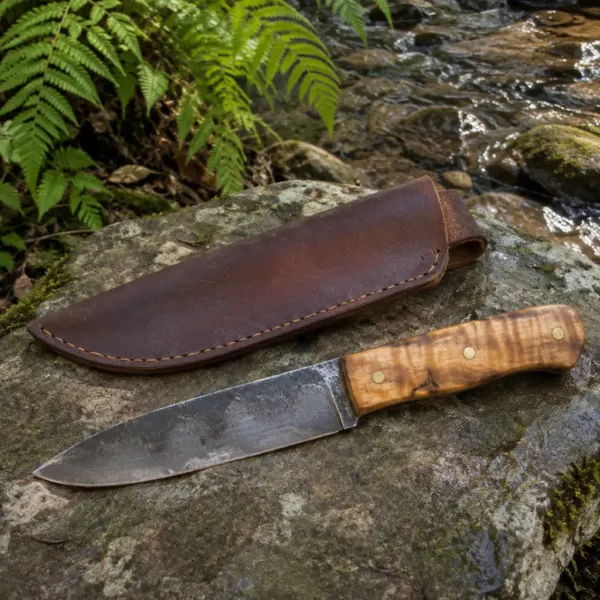
Elk Garden Belt Knife, Curly Maple
5.25 in blade · Maple
Belt Knife with a 5.25 in hand-forged blade, curly maple scales and a leather sheath. A fixed blade belt knife for everyday camp and field work.
$255.00Free US shipping -
 New
Walnut Bottom Trail Knife, White Ash
5.5 in blade · Ash
Trail Knife with a 5.5 in hand-forged blade, white ash scales and a fringed leather sheath.
$270.00Free US shipping -
 New
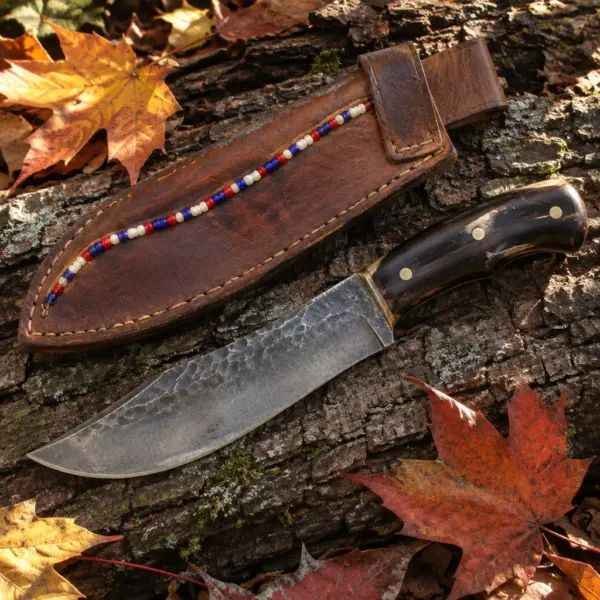
Burkes Garden Mountain Man Knife, Bison Horn
6.25 in blade · Buffalo horn
Mountain Man Knife with a 6.25 in hand-forged blade, polished black bison horn scales and a beaded leather sheath.
$330.00Free US shipping -
 New
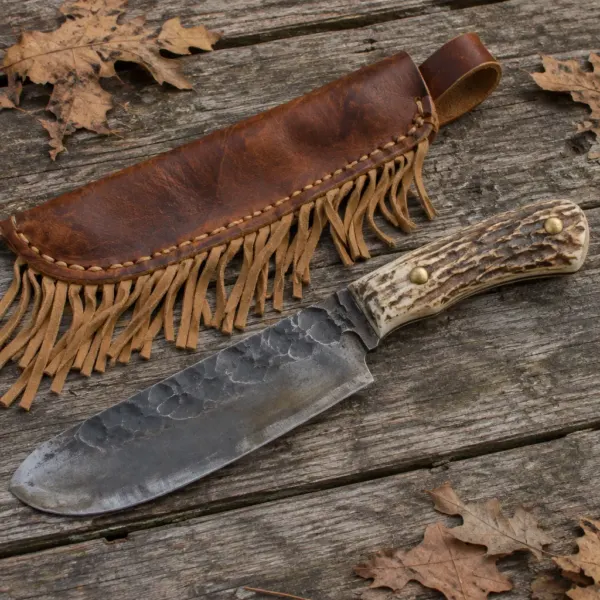
Craggy Pinnacle Trade Butcher Knife, Deer Antler
6.5 in blade · Antler
Trade Butcher Knife with a 6.5 in hand-forged blade, whitetail deer antler scales and a fringed leather sheath.
$360.00Free US shipping
Keep Reading

Knife Handle Materials: Antler, Horn, Hardwood and Bone Compared
How antler, horn, hardwood, bone and wrapped handles look, feel and age, and how to look after each one.

What Is a Neck Knife? How to Wear, Carry and Choose One
A small fixed blade worn on a cord. Where the idea comes from, how to wear one safely and what size to choose.

How to Use Flint and Steel to Start a Fire
What you need, how the sparks are made and the steps from first strike to open flame.