What Is a Bowie Knife? History, Blade Shapes and How to Choose
Few knives are as recognizable as the Bowie. It began as a frontier fighting and camp knife in the 1820s and became the pattern every big American knife is measured against.

A Short History
The knife takes its name from James Bowie, who became famous after a brawl known as the Sandbar Fight near Natchez, Mississippi, in 1827, where he used a large knife. Accounts differ on who designed that first knife. His brother Rezin Bowie claimed the design, and later versions are often linked to the Arkansas blacksmith James Black, though that attribution is still debated.
What is certain is that demand exploded. By the 1830s and 1840s cutlers in Sheffield, England, and across the United States were making Bowie knives by the thousand, and the name came to mean a style, not a single knife.

What Makes a Knife a Bowie
- Size: a large fixed blade, most often 6 to 12 inches long.
- Clip point: the front of the spine is cut away, straight or concave, to form a sharp point. Many have a false edge along the clip.
- Crossguard: a brass or steel guard between the blade and handle.
- A stout spine: enough weight and strength to chop.
Common Patterns
- Clip point Bowie: the classic. A fine tip for piercing and plenty of belly for slicing.
- Frontier Bowie: broad, plain and heavy, in the style carried in the 1830s.
- Camp Bowie: shorter and handier, usually 7 to 8.5 inches, built to baton firewood and prepare food.
- Spear point Bowie: a symmetrical tip on the center line of the blade, strong and balanced.
- Coffin handle: a grip that flares toward the butt, one of the earliest handle styles.
- Rifleman’s knife: the long plain belt knife of the colonial frontier, a forerunner of the Bowie.
A Bowie is a big knife that can do a small axe's work.
How to Choose
- For camp work: 7 to 9 inches. Long enough to chop and split kindling, short enough to slice with.
- For display and collecting: 9 to 11 inches, where the pattern shows at its best.
- Tang: a full tang is strongest. Look for visible pins through the handle.
- Handle: horn and antler for looks and grip, hickory or oak for hard use. See knife handle materials.
- Sheath: heavy leather with a belt loop, stitched and fitted to the blade.
Using and Caring for a Bowie
A Bowie will chop, split and slice. It is not the best tool for fine skinning, where a smaller blade gives more control. Carry a second knife for that; our guide to skinning knife blade shapes explains the options.
Dry and oil the blade after use and store it out of the sheath, as described in the knife care guide. Laws on carrying large fixed blades vary by state, so check the rules before you carry one off your own land.
Parts of a Bowie Knife
- Clip: the cut-away section at the front of the spine. It can be straight or concave.
- Swedge, or false edge: a bevel ground along the clip. It thins the tip so it pierces more easily, and on most knives it is left unsharpened.
- Belly: the curved part of the edge that does the slicing.
- Ricasso: the flat, unsharpened section between the edge and the guard.
- Spanish notch: a small notch at the base of the edge on some historic Bowies. Collectors still argue about what it was for.
- Crossguard: the bar that stops the hand sliding forward. On early knives it is often a simple oval of brass.
- Pommel: the butt of the handle, sometimes capped in brass or steel.
Bowie Knife vs Arkansas Toothpick
In the 1830s and 1840s the two names were often used for the same knives. Today they mean different things. A Bowie has a single edge, a clip point and enough belly to slice and chop. An Arkansas toothpick is a long, straight dagger that tapers evenly to a needle point and is sharpened on both edges. One is a camp and hunting knife. The other is a thrusting blade, and now mainly a collector’s piece. You will find toothpicks among our dagger knives.
The Bowie After the Frontier
James Bowie died at the Alamo in March 1836, and the legend only grew. Large Bowies with D-shaped knuckle guards were carried by many Confederate soldiers early in the Civil War. As revolvers and repeating rifles spread, the big fighting knife gave way to shorter hunting and camp patterns.
The shape never went away. The fighting and utility knife adopted by the United States Marine Corps in 1942 is a clip point in the Bowie tradition, and most American hunting knives of the last century borrow the same lines.
Common Questions
What is a Bowie knife?
A Bowie knife is a large fixed-blade knife with a clip point, a crossguard and a blade usually 6 to 12 inches long. It is named after the frontiersman James Bowie.
Who was the Bowie knife named after?
James “Jim” Bowie, born in Kentucky in 1796, who became famous for the Sandbar Fight of 1827 and died at the Alamo in 1836.
What is a Bowie knife used for?
Camp work, mainly: chopping, splitting kindling, clearing brush and preparing food. It also serves as a hunting knife for large game, and decorated examples are collected and displayed.
How long is a Bowie knife?
Most have blades of 6 to 12 inches and an overall length of 11 to 17 inches. Camp Bowies sit at the short end, display pieces at the long end.
Is a Bowie knife good for survival?
A camp-sized Bowie with a full tang is a capable one-tool option, since it chops, batons and slices. Pair it with a small knife for fine work.
Hand-Forged Bowie Knives
Clip point, frontier and camp Bowies with horn, antler and hardwood handles.
-
 New
Warwoman Dell Spear Point Bowie Knife, Rawhide Wrap
8 in blade · Rawhide
Spear Point Bowie Knife with a 8 in hand-forged blade, rawhide lacing wrapped over the tang wrap and a leather sheath.
$340.00Free US shipping -
 New
Laurel Run Coffin-Handle Bowie Knife, White Ash
9.25 in blade · Ash
Coffin-Handle Bowie Knife with a 9.25 in hand-forged blade, white ash scales and a beaded, fringed sheath.
$410.00Free US shipping -
 New
Curley Maple Gap Camp Bowie Knife, Osage Orange
8.5 in blade · Osage orange
Camp Bowie Knife with a 8.5 in hand-forged blade, osage orange scales and a beaded leather sheath.
$365.00Free US shipping -
 New
Roaring Fork Frontier Bowie Knife, White Oak
9.25 in blade · White oak
Frontier Bowie Knife with a 9.25 in hand-forged blade, white oak scales and a beaded, fringed sheath with feathers.
$425.00Free US shipping
Keep Reading
How to Choose a Tomahawk: Head Shapes, Haft Length and Weight
Head shape, haft length and weight: what matters for camp work, what matters for throwing and what matters on the wall.
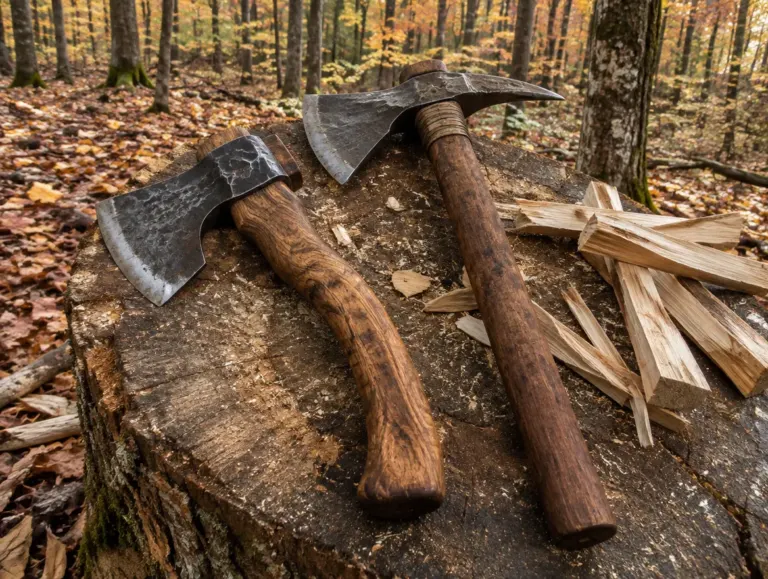
Tomahawk vs Hatchet: What Is the Difference?
They look alike, but the eye, the haft and the weight are different. Here is how to tell them apart and which one suits your work.

How to Throw a Tomahawk: Distance, Grip and Rotation
A safe setup, the right distance, a relaxed grip and one clean rotation. Everything a beginner needs for the first stick.