Best EDC Knife: How to Pick One You Will Actually Carry
The best EDC knife is the one still in your pocket at four in the afternoon. Not the one that looked great online and now lives in a kitchen drawer. This guide covers how to pick an everyday carry knife you will actually carry: folding or fixed, how long a blade, which steel and what to keep it in.

What an EDC Knife Is For
EDC stands for everyday carry, the small kit that goes with you without any planning. Keys, wallet, phone and, for a lot of us, a knife. The work it does is not glamorous. It opens boxes and feed sacks, cuts baling twine, trims a loose thread, slices an apple at lunch and now and then puts a point on a tent stake.
None of that needs a ten inch blade, though plenty of people buy one anyway. The real test of an EDC knife is simple. If it is too heavy, too long or too awkward, you will leave it at home, and a knife at home cuts nothing. It does stay very clean, I will give it that. Everything else in this guide follows from that one rule.
Folding Knife or Small Fixed Blade
Most people picture a pocket knife when they hear EDC, and for good reason. A folding knife tucks its edge inside the handle, so it rides in a pocket or a belt pouch without cutting anything it should not. A small fixed blade has no moving parts. There is nothing to work loose, no pivot to pick grit out of and nothing that can fold shut on your fingers. It does need a sheath, and the sheath matters as much as the knife.
When a folding knife makes sense
You work in town or around people, you wear jeans or work pants, and you want the knife out of sight until you need it. Our pocket knives include slip joints, lockbacks, liner locks and friction folders. The Mineral Bluff Slip Joint Pocket Knife closes to 4 inches around a 3.25 inch drop point blade. The Mount Guyot Sheepsfoot Folding Knife closes to 3.25 inches and weighs 3.2 ounces, which is about as small as a working knife gets before it turns into a key chain ornament.
When a small fixed blade makes sense
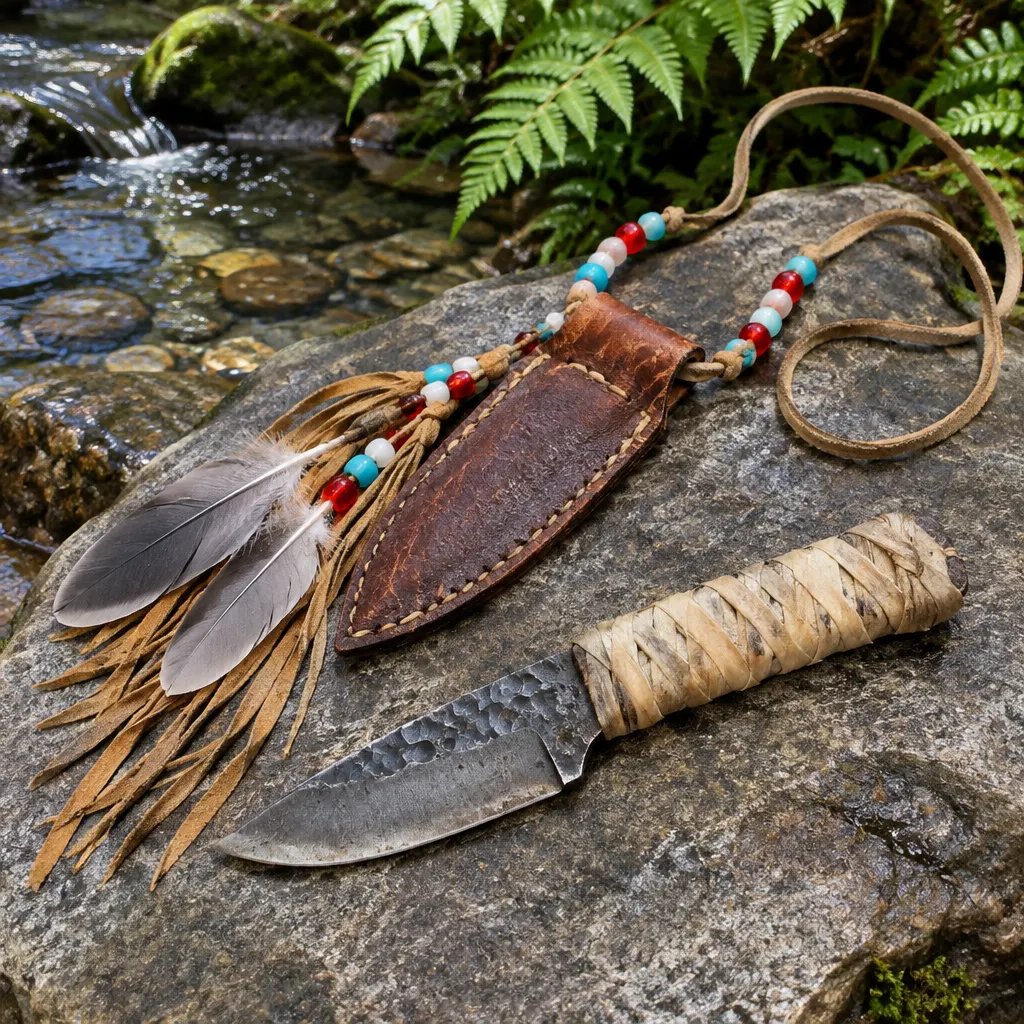
You spend your days outdoors, on a farm, at camp or in the field. You want a blade you can draw with one hand, use with wet or gloved hands and wipe clean on your jeans. A neck knife is the easy way to carry one. Our neck knives have blades from 2.25 to 3.25 inches and weigh 2.2 to 4.6 ounces, and each one rides in a leather neck sheath on a buckskin cord. If you have never worn one, read what a neck knife is and how to wear it before you buy.
Blade Length: Smaller Than You Think
For everyday chores a blade of about 2.5 to 3.5 inches does nearly everything. Much shorter and the knife starts to feel like a letter opener. Much longer and it gets heavy in the pocket, catches on the seat belt and draws looks at the hardware store. Long blades belong to camp, hunting and chopping, which is a different knife and a different guide.
Here are six knives from our shop that sit in the everyday range. The numbers come straight from the product pages.
| Knife | Type | Blade | Weight |
|---|---|---|---|
| Mount Guyot, Dogwood | Folding sheepsfoot | 2.5 in | 3.2 oz |
| Armstrong Creek, Osage Orange | Lockback, clip point | 3 in | 4.3 oz |
| Mineral Bluff, Deer Antler | Slip joint, drop point | 3.25 in | 4.2 oz |
| Gray Fox, Horn and Red Comb | Liner lock, drop point | 3.5 in | 5.8 oz |
| Copper Ridge, Rawhide Wrap | Neck knife, drop point | 3 in | 4.1 oz |
| Derrick Knob, Bone | Neck knife, drop point | 3 in | 4.1 oz |
Pick a Blade Shape for the Work You Do
- Drop point: the spine slopes down to a strong tip with plenty of belly behind it. If you only own one knife, this is the shape to own.
- Sheepsfoot: a straight edge and a rounded nose. Good for opening packages when you would rather not stab whatever is inside, and kind to anyone who cuts down onto a work surface.
- Clip point: a finer, lower tip for detail work and picking at knots. The thin tip snaps if you pry with it, so don’t.
- Spear point: a symmetrical tip on the center line of the blade, strong and easy to control.
A knife at home cuts nothing. Pick the one you will carry.
Locks, Springs and Fingers
A folding knife either locks open or it does not. A slip joint has no lock. A spring holds the blade open and closed, and that is plenty for cutting as long as the pressure goes onto the edge and not onto the back of the blade. A lockback or a liner lock holds the blade open until you release it, which is reassuring for harder work. A friction folder has neither a spring nor a lock. Your thumb on the extended tang keeps it open, and it is the oldest kind of folding knife there is.
None of them is wrong for everyday carry. What matters is that you know how yours opens and closes before you need it in a hurry. Our guide on how to close a pocket knife walks through each type step by step.
Steel: What High Carbon Asks of You
Nearly every blade we sell is hand forged high carbon steel, and all of the knives in this guide are. It takes a keen edge and comes back quickly on a stone, which matters on a knife you use every day. The catch is that it will rust if you put it away wet. With use it also darkens to a gray patina. That patina is normal and gives the steel a little protection, so there is no need to polish it off.
The care routine is short. Wipe the blade dry after use, put a drop of oil on the steel now and then, and do not leave the knife folded up wet in a pocket after a rainy day. Stainless steel asks for less, but it is slower to sharpen at the kitchen table.
Handle and Carry
A handle should fill your hand without hot spots. Antler, horn and bone grip well and age nicely. Hardwoods like osage orange and curly maple feel warm and get better with handling. Check the closed length against your palm, because a handle that is too short leaves your little finger hanging off the end.
Think about where the knife rides. Most of our folders ship in a fitted leather belt pouch, so you can wear the knife on the belt instead of in the pocket. Our neck knives ride on a buckskin cord under the shirt. Whatever you choose, test the fit. Turn a neck sheath upside down over a bed and give it a shake. If the knife falls out over the bed, it will fall out in a parking lot too.
Carry Laws: Check Before You Carry
Knife laws in the United States change from state to state and sometimes from city to city. Some places limit blade length. Some treat fixed blades differently from folders, and some care whether the knife is concealed. Schools, courthouses and federal buildings have their own rules, and the TSA does not allow pocket knives in carry-on bags, so a knife that flies goes in checked luggage. We are knife makers, not lawyers. Look up your state and city rules before you carry, and look them up again before a road trip.
Questions and Answers
What is the best blade length for an EDC knife?
For most people, 2.5 to 3.5 inches. That length handles boxes, cord, food and small repairs while staying light in the pocket. Go longer only if your daily work really needs it.
Is a fixed blade a good EDC knife?
A small one is. A 3 inch fixed blade in a neck sheath is strong, quick to draw and easy to clean. Check your local laws first, because some places treat fixed blades differently from folders.
Is a slip joint strong enough for everyday carry?
Yes, for cutting. Slip joints did farm and ranch chores for generations. Because there is no lock, do not use one to pry or stab, and keep the pressure on the edge.
Does a high carbon steel knife rust?
It can if it is left wet. Wipe it dry, oil it lightly now and then and let it build a patina. A knife that gets used and wiped every day rarely has a rust problem.
Can I take my EDC knife on a plane?
Not in the cabin. The TSA does not allow pocket knives in carry-on bags, so pack it in checked luggage and check the rules where you land as well.
Pieces that go with this guide: Mineral Bluff Slip Joint Pocket Knife, Deer Antler, Armstrong Creek Lockback Pocket Knife, Osage Orange, Gray Fox Liner Lock, Horn and Red Comb, Copper Ridge Neck Knife, Rawhide Wrap and Derrick Knob Neck Knife, Bone.
Keep exploring
Shop by collection
- Native American-Style Knives
- Fixed Blade Knives
- Signature Collection
- EDC Knives
- Tomahawks & Axes
- Bearded Axes
- Throwing Axes and Tomahawks
- Tomahawks
- Double Bit Axes
- Axes & Hatchets
- Hunting & Skinning Knives
- Gut Hook Knives
- Skinning Knives
- Pocket Knives
- Antler and Bone Handle Knives
- Camp & Bushcraft Knives
- Neck Knives & Small Fixed Blades
- Bowie Knives
- Daggers
- Boot Knives
- Ring Pommel Knives
- Heritage Tools
- Fire Starting Kits
- Leather Awls
- Ulu Knives
- Gift Sets & Combos
- Damascus Knives
- War Clubs
- Spears & Lances
- Shop everything
Hand Forged EDC Knives
Pocket knives and small fixed blades built for everyday carry.
-
 New
Elk Knob Damascus Neck Knife with Sheath, Ram Horn
3.25 in blade · Ram horn
A neck knife with a 3.25 in hand forged Damascus steel drop point, ridged ram horn scales and a brown leather sheath that hangs from the neck or…
$190.00Free US shipping -
 New
Cataloochee Elk Damascus Lockback with Feathers
4 in blade · Buffalo horn
A large lockback pocket knife with a 4 in hand forged Damascus steel clip point, black buffalo horn handle, trade beads and two pigeon feathers, in a fringed…
$375.00Free US shipping -
 New
Tilson Gap Damascus Stockman Pocket Knife, Bison Horn
3.75 in blade · Buffalo horn
A three blade stockman pocket knife with a 3.75 in hand forged Damascus steel blade, polished black bison horn scales, steel bolsters and a fitted leather belt pouch.
$345.00Free US shipping -
 New
Haoe Damascus Lockback Pocket Knife, Ram Horn
3.75 in blade · Ram horn
A lockback pocket knife with a 3.75 in hand forged Damascus steel clip point, ridged ram horn scales and a fringed leather belt pouch with beadwork.
$345.00Free US shipping


Keep Reading

Camp Axe vs Hatchet: Which One to Carry Camping
Weight, handle length, chopping and splitting: how a hatchet and a camp axe differ, and which one to carry for your kind of camping.

What to Put in a Fire Starter Kit (and What to Leave Out)
Spark source, char cloth, tinder, a tin that stays dry and a backup flame: what goes in a fire starter kit and how to keep it working.
Battle Axe Types Through History, From the Francisca to the Tomahawk
The francisca, the bearded axe, the Dane axe, the poleaxe and the tomahawk, plus the truth about double bit axes.