Battle Axe Types Through History, From the Francisca to the Tomahawk
A battle axe is an axe made for fighting rather than firewood. That sounds like a fine distinction until you hold one, because most were lighter, thinner and quicker than the wood axe in your garage. Here are the main battle axe types through history, where each one came from and what it was for, with the movie myths left at the door. You can see the old outlines in steel among our bearded axes.
What Makes an Axe a Battle Axe
A wood axe is built to drive a wedge of steel into timber. A battle axe is built to cut through a person, a shield or a mail shirt, and for that it needs speed more than mass. Fighting axes ran from about one pound to about seven, with heads that were often narrow and thin behind the edge. Most weighed far less than a modern splitting axe. A splitting maul would make a poor weapon for exactly the reason it makes a good wood splitter.
The axe had another thing going for it. It cost far less than a sword, and any man who had cut his own firewood already knew how to swing one. In Scandinavia the same axe served as a tool and a weapon, which goes a long way toward explaining why it was so common there.
Most battle axes were lighter and quicker than the wood axe in your garage.
Battle Axe Types Through History
The francisca
The francisca was the throwing axe of the Franks, the people who gave France its name, and it belongs to roughly AD 500 to 750. The head arches forward and widens toward the edge on a short haft of about 16 to 18 inches. The Byzantine historian Procopius wrote that the Franks threw their axes together, on a signal, in the first charge, to break shields and kill the men behind them. Examples have turned up in England too, so the Anglo-Saxons knew the pattern.
The bearded axe
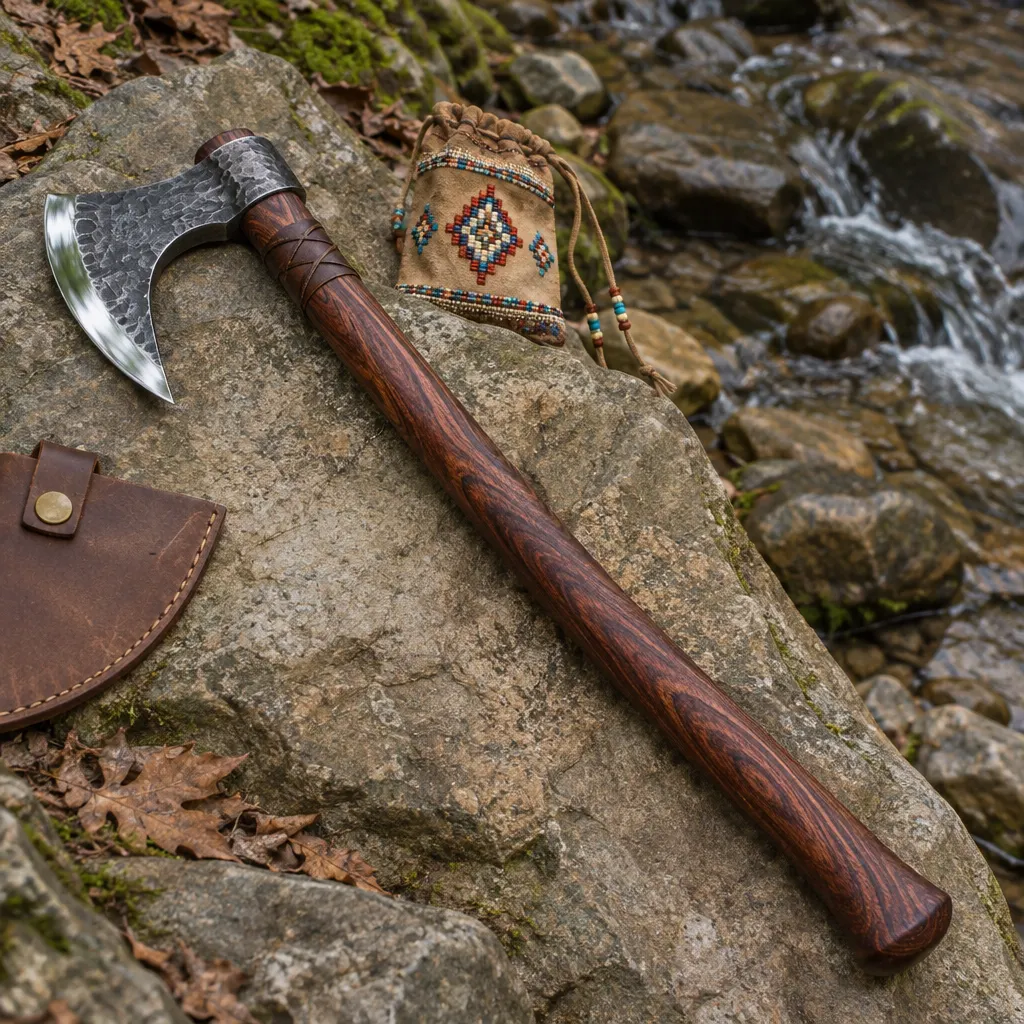
The bearded axe takes its name from the Old Norse skeggøx. The beard is the lower part of the edge that hangs down below the rest of the head. That shape gives a long cutting edge while keeping the head light. In a fight the beard could hook the rim of a shield or an opponent’s weapon and drag it out of the way. Outside a fight it was a working axe, used across medieval Europe. For the rest of the Norse kit, from spears to shields, see our guide to Viking weapons.
The Dane axe
The Dane axe is the big one. It was a two handed axe with a haft of roughly 3 to 4 feet for fighting, a head of about 2 to 4.5 pounds and an edge of 8 to 12 inches. It spread across Europe from the 10th century. At Hastings in 1066 the housecarls of King Harold’s bodyguard fought with it, and the Bayeux Tapestry shows it almost only in the hands of well armored men. Scandinavians carried it into the Varangian Guard of the Byzantine emperors, and in western Scotland and Ireland the simple Dane axe stayed in use into the 16th century.
The poleaxe and the horseman’s axe
Once knights were wearing plate armor, the axe changed again. By the 15th century the poleaxe had appeared: an axe blade, a hammer or back spike and a top spike on a long haft, built to break and pierce armor in fighting on foot. Mounted men carried shorter axes they could swing in one hand. The best known story belongs to Robert the Bruce, who killed the English knight Henry de Bohun with one blow of his axe on the first day of Bannockburn in 1314. His main complaint afterward, so the story goes, was that he had broken a good axe.
The tomahawk
The tomahawk is America’s own battle axe. The word comes from the Powhatan language of Virginia and entered English in the 1600s. Before contact, heads were made of stone, bone or antler and lashed to a wooden handle with rawhide. European traders brought iron heads, and the iron trade hatchet became a common trade item. Pipe tomahawks, with a smoking bowl on the poll, were made as trade goods and diplomatic gifts. Through the 1700s Native warriors, frontiersmen and colonial soldiers carried tomahawks as a tool first and a weapon when needed. Our guide on how to choose a tomahawk covers the patterns, and our tomahawks run from belt hawks to spike hawks.
The double bit, and an honest correction
Fantasy art loves a double headed battle axe. History is less keen. The labrys of Bronze Age Crete was a sacred symbol more than a weapon. The Norse did not forge double bit axes, and no Viking example has ever turned up. The double bit as most Americans know it is a logging tool. It was probably first made in Pennsylvania around 1850 and became popular with loggers in the last quarter of the 19th century. Our double bit axes are modern pieces made for looks, balance and honest work. Enjoy them for that, and enjoy the movies for what they are.

Battle Axe Types at a Glance
| Type | Era | Carried by | Used for |
|---|---|---|---|
| Francisca | About AD 500 to 750 | Franks | Thrown in the first charge |
| Bearded axe | Early Middle Ages and the Viking Age | Norse and other northern Europeans | Cutting, hooking shields, everyday work |
| Dane axe | 10th to 14th century | Housecarls, the Varangian Guard | Two handed cleaving |
| Poleaxe | 15th century onward | Armored men at arms | Fighting on foot against plate armor |
| Tomahawk | Stone before contact, iron from the 1600s | Native nations, traders, frontiersmen | Tool, weapon and trade item |
| Double bit axe | From about 1850 | American loggers | Felling timber, not fighting |
Forged Battle Axes in Our Shop
We do not sell museum reproductions. The axes below take the old outlines and forge them in high carbon steel on hardwood handles, made to be used or hung on the wall. A few examples, with the numbers from their product pages:
- Ironweed Hammered Bearded Axe, Rosewood: 24 inches overall, a 5 inch edge and 36 ounces, with a hammered head.
- Chestnut Ridge Bearded Axe with Peacock Feathers: 22 inches and 32 ounces, with a leather wrapped rosewood haft.
- Noontootla Bearded Hawk, Black Cherry: a lighter hawk at 19 inches and 27 ounces, with a long hooked bit.
- Balsam Gap Hammered Double-Bit Axe: a full size double bit, 28 inches and 52 ounces.
- Cross Mountain Spike Tomahawk, White Ash: 19 inches and 22 ounces, with a forged back spike.
Choosing one
For the wall, pick the outline you like and the wood you like looking at. For use, weight and haft length matter more. A hawk of 22 to 27 ounces on a 19 inch haft is quick in one hand. A bearded axe of 32 to 36 ounces on a 22 to 24 inch haft wants a firmer grip and does more work per swing. Whatever you buy, keep the leather edge cover on when it is not in use, and hang it somewhere nobody rests their head.
Questions and Answers
What is a battle axe?
An axe designed for combat rather than for cutting wood. Most had lighter, thinner heads than work axes so they could be swung fast and brought back quickly.
Did Vikings use double headed axes?
No. No double bit axe has been found from the Viking Age, and the Norse did not make them. Vikings used single bit axes, including the bearded axe and the two handed Dane axe.
How heavy was a battle axe?
Anywhere from about one pound to about seven, depending on the type. A Dane axe head weighed roughly 2 to 4.5 pounds, and a throwing axe like the francisca was lighter still.
What is the difference between a battle axe and a regular axe?
A work axe is heavy and wedge shaped so it can chop and split wood. A battle axe gives up that mass for speed, with a thinner bit and often a longer edge, like the beard on a bearded axe.
Is a tomahawk a battle axe?
Historically it was both a tool and a weapon. Native warriors and frontier soldiers carried tomahawks into battle, and the same hawk chopped firewood that night. Today most are used for camp work and throwing.
Were battle axes thrown?
Some were. The Frankish francisca was thrown together by a whole line of men at the start of a charge. Most other battle axes stayed in the hand.
Pieces that go with this guide: Ironweed Hammered Bearded Axe, Rosewood, Chestnut Ridge Bearded Axe with Peacock Feathers, Noontootla Bearded Hawk, Black Cherry, Balsam Gap Hammered Double-Bit Axe and Cross Mountain Spike Tomahawk, White Ash.
Keep exploring
Shop by collection
- Native American-Style Knives
- Fixed Blade Knives
- Signature Collection
- EDC Knives
- Tomahawks & Axes
- Bearded Axes
- Throwing Axes and Tomahawks
- Tomahawks
- Double Bit Axes
- Axes & Hatchets
- Hunting & Skinning Knives
- Gut Hook Knives
- Skinning Knives
- Pocket Knives
- Antler and Bone Handle Knives
- Camp & Bushcraft Knives
- Neck Knives & Small Fixed Blades
- Bowie Knives
- Daggers
- Boot Knives
- Ring Pommel Knives
- Heritage Tools
- Fire Starting Kits
- Leather Awls
- Ulu Knives
- Gift Sets & Combos
- Damascus Knives
- War Clubs
- Spears & Lances
- Shop everything
Hand Forged Battle Axes
Bearded axes, double bit axes and tomahawks on hardwood hafts.
-
 New
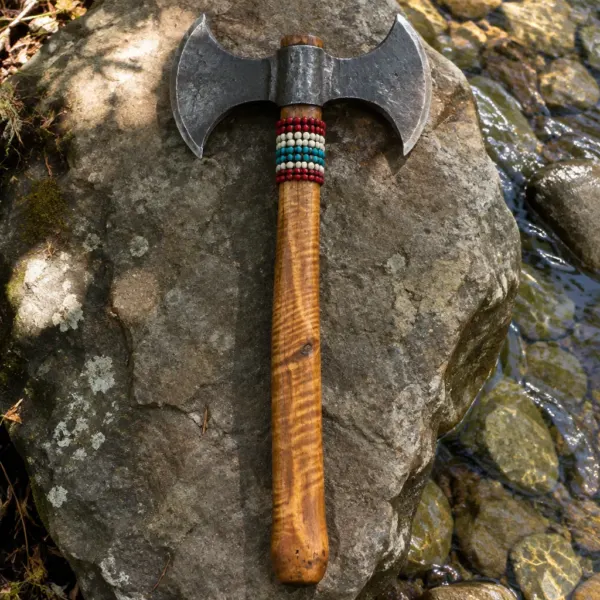
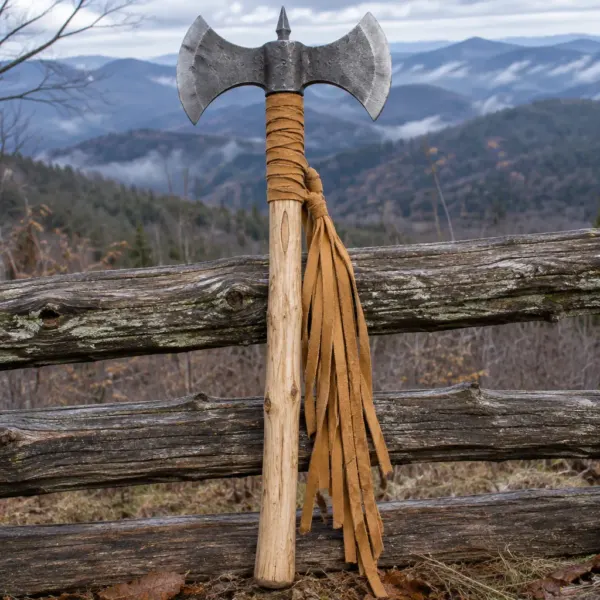
Sinking Creek Crescent Double-Bit Tomahawk, Curly Maple
4.25 in blade · Maple
Crescent Double-Bit Tomahawk with a double-bit head with two crescent edges, hand-forged in high-carbon steel, on curly maple.
$440.00Free US shipping -
 New
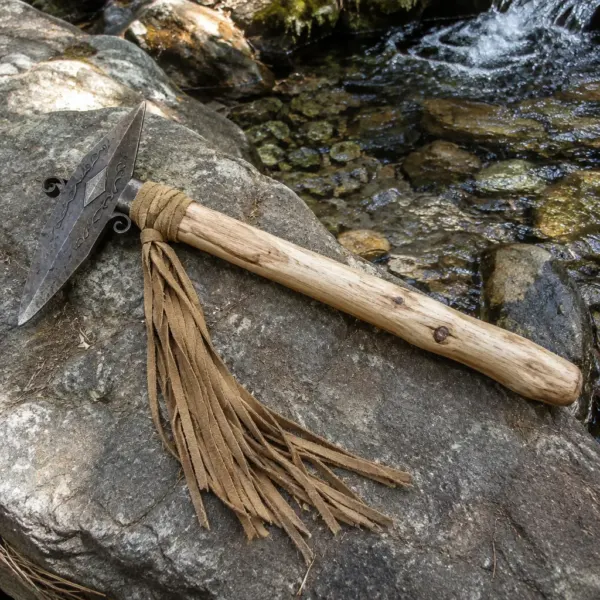
Grassy Cove Spearhead Double-Bit Tomahawk, White Ash
3.75 in blade · Ash
Spearhead Double-Bit Tomahawk with a double-bit head topped with a forged spear point, hand-forged in high-carbon steel, on white ash.
$420.00Free US shipping -
 New
Tricorner Knob Spontoon Tomahawk, White Ash
5.25 in blade · Ash
Spontoon Tomahawk with a spontoon head with a spear-shaped blade and curled side lugs, hand-forged in high-carbon steel, on white ash.
$355.00Free US shipping -
 New
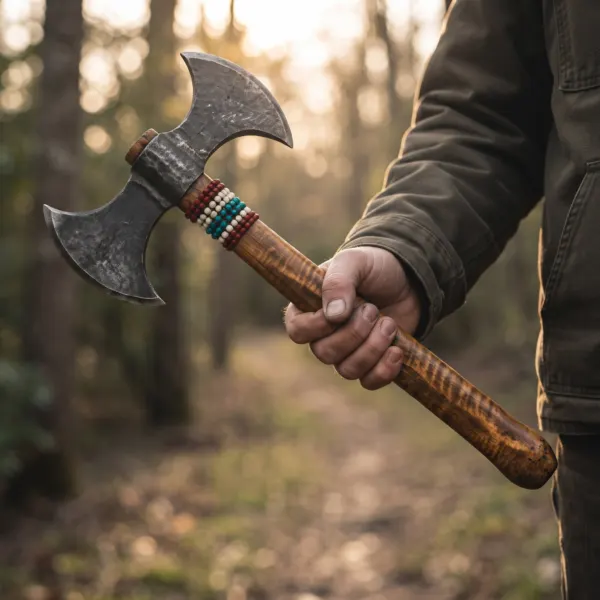
Laurel Creek Gap Double-Bit Tomahawk, White Oak
3.75 in blade · White oak
Double-Bit Tomahawk with a double-bit head with two matched flared edges, hand-forged in high-carbon steel, on white oak.
$395.00Free US shipping
Keep Reading
How to Carry a Boot Knife: Sheaths, Carry Options and Fit
What a boot knife is, the ways to wear one, what to look for in a sheath and why the law comes first.

How to Sharpen a Pocket Knife: Angle, Stones and Small Blades
The angle to hold, the strokes to use and how to handle short, curved and multi blade folders without losing a fingertip.

Best Skinning Knife for Deer and Small Game: How to Choose
Blade shapes, gut hooks, blade length, grip and sheath: how to choose a skinning knife for deer and small game.