How to Sharpen a Pocket Knife: Angle, Stones and Small Blades
A pocket knife dulls faster than any other knife you own, because it does the most work and gets the least respect. Cardboard, tape, zip ties, the occasional staple. The good news is that a small folding blade is quick to sharpen once you know how to sharpen a pocket knife at the right angle, and a few habits keep all ten fingers where they belong.
What You Need
- A whetstone: a combination stone with a medium side, around 1000 grit, and a fine side, 3000 grit or finer. A narrow pocket stone works too and travels better.
- A leather strop: a strip of leather glued to a flat board, with a little polishing compound if you have it.
- A permanent marker: the cheapest angle guide there is.
- Water or honing oil, depending on your stone, and a rag.
Leave the bench grinder alone. It takes steel off fast and can overheat a thin pocket knife edge, which ruins the temper at the very spot you are trying to sharpen.
The Right Pocket Knife Sharpening Angle
Most pocket knives do well at about 17 to 20 degrees per side. Per side means the angle between one face of the edge and the stone. Add both sides together and you get the inclusive angle, so 20 degrees per side is a 40 degree edge. When someone quotes you a single number, ask which one they mean. It saves arguments.
A lower angle slices better but chips and rolls sooner. A higher angle is tougher but pushes through material instead of slicing it. Pick by how you use the knife:
| Angle per side | Inclusive angle | Good for |
|---|---|---|
| About 15 degrees | About 30 degrees | Thin slicing blades, pen blades and whittling. Very sharp, needs more frequent touch ups. |
| 17 to 20 degrees | 34 to 40 degrees | Most pocket knives and everyday carry. The best balance for most people. |
| 20 to 25 degrees | 40 to 50 degrees | Hard use: cardboard all day, cutting near dirt, rough outdoor work. |
| 25 to 30 degrees | 50 to 60 degrees | Hatchets and tomahawks, not pocket knives. |
Finding the angle without a gauge
Take a square piece of paper and fold one corner in half. That gives you 45 degrees. Fold it in half again and you have about 22 degrees. Lay the blade against that fold to see what roughly 20 degrees looks like, then drop the spine a hair lower.
Then use the marker. Color the edge bevel, make one light stroke on the stone and look. If the ink is gone across the whole bevel, you are matching the existing angle. Ink gone only at the very edge means your angle is too high. Ink gone only at the top of the bevel means too low.
Step by Step on a Whetstone
- Clean the knife and open one blade fully. On a multi blade knife, open only the blade you are sharpening.
- Set the stone on a damp towel so it cannot slide, and wet or oil it.
- Start on the medium side. Lay the blade at your angle with the edge leading, as if you were shaving a thin slice off the top of the stone.
- Push the whole edge across the stone, sweeping from heel to tip. As you reach the belly, lift the handle slightly so the curve stays in contact with the stone.
- Work one side until you raise a burr, a faint wire of steel you can feel with a fingertip on the opposite side, along the full length of the edge.
- Turn the blade over and repeat until the burr moves back to the first side.
- Move to the fine side with lighter pressure, alternating sides every few strokes, then single strokes, until the burr is gone.
- Strop, then test by slicing a sheet of paper from heel to tip.
Count your strokes on each side and keep them even. A small pocket knife blade often needs only a couple of dozen strokes per side on the medium stone if it is not badly damaged.
Hold the angle, raise a burr, take it off. Everything else is detail.
Small Blades, Curved Blades and Multi Blade Knives
Pocket knives bring a few problems the big kitchen knife never has.
Short blades
On a 2.5 inch blade it is easy to round off the tip by sweeping too far. Use shorter strokes, work near the edge of the stone and stop the sweep when the tip reaches the stone’s edge. Check the tip under good light. A rounded tip is the most common sign of overenthusiastic sharpening.
Hawkbills and other curved edges
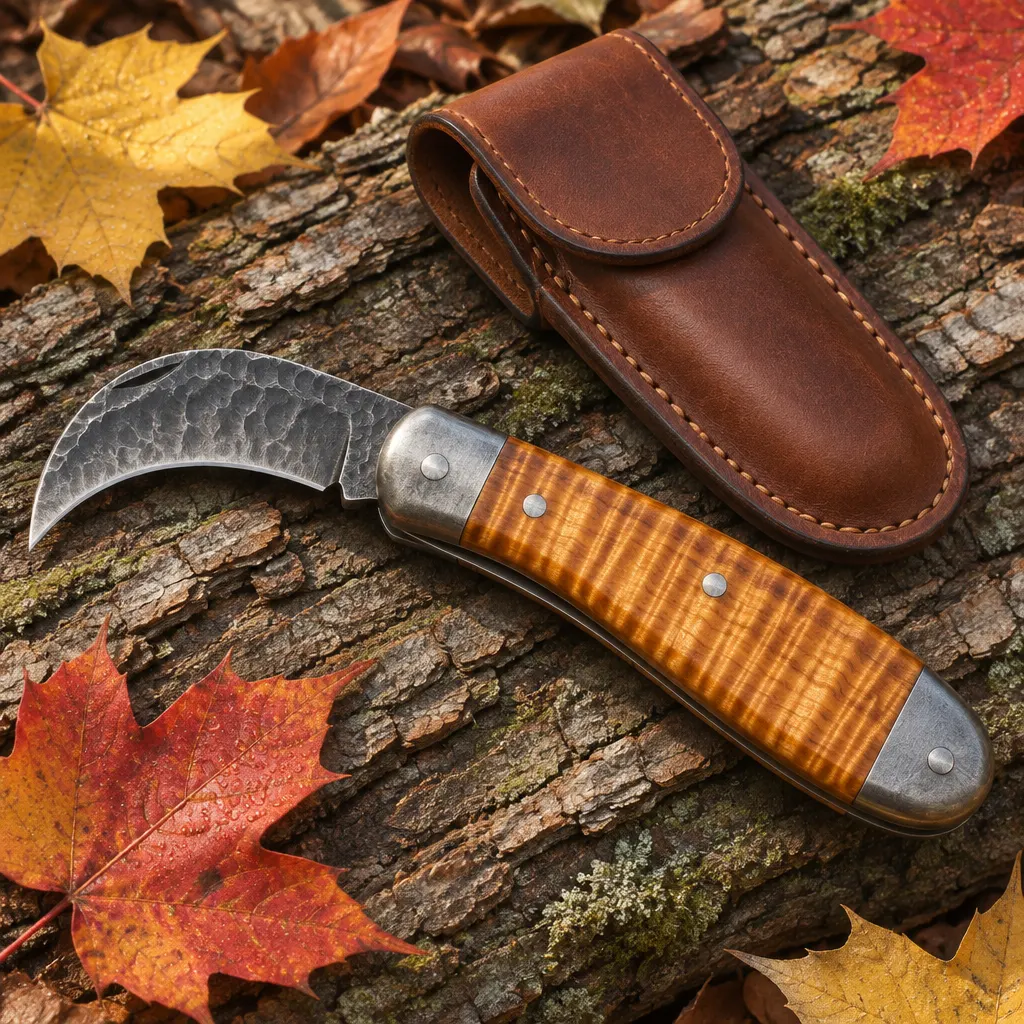
A hawkbill like the Burningtown Hawkbill Folding Knife, Curly Maple curves inward, so the flat face of a stone cannot reach the middle of the edge. Use the rounded corner of the stone, or a small round ceramic rod, and work the curve in short sections from heel to tip. Keep the angle the same as you go around the bend.
Straight edges
A sheepsfoot such as the Mount Guyot Sheepsfoot Folding Knife, Dogwood is the easiest blade you will ever sharpen. The edge is straight, so you can keep it flat on the stone and push straight across. If you are new to this, practice on a straight edge first.
Stockmen and trappers
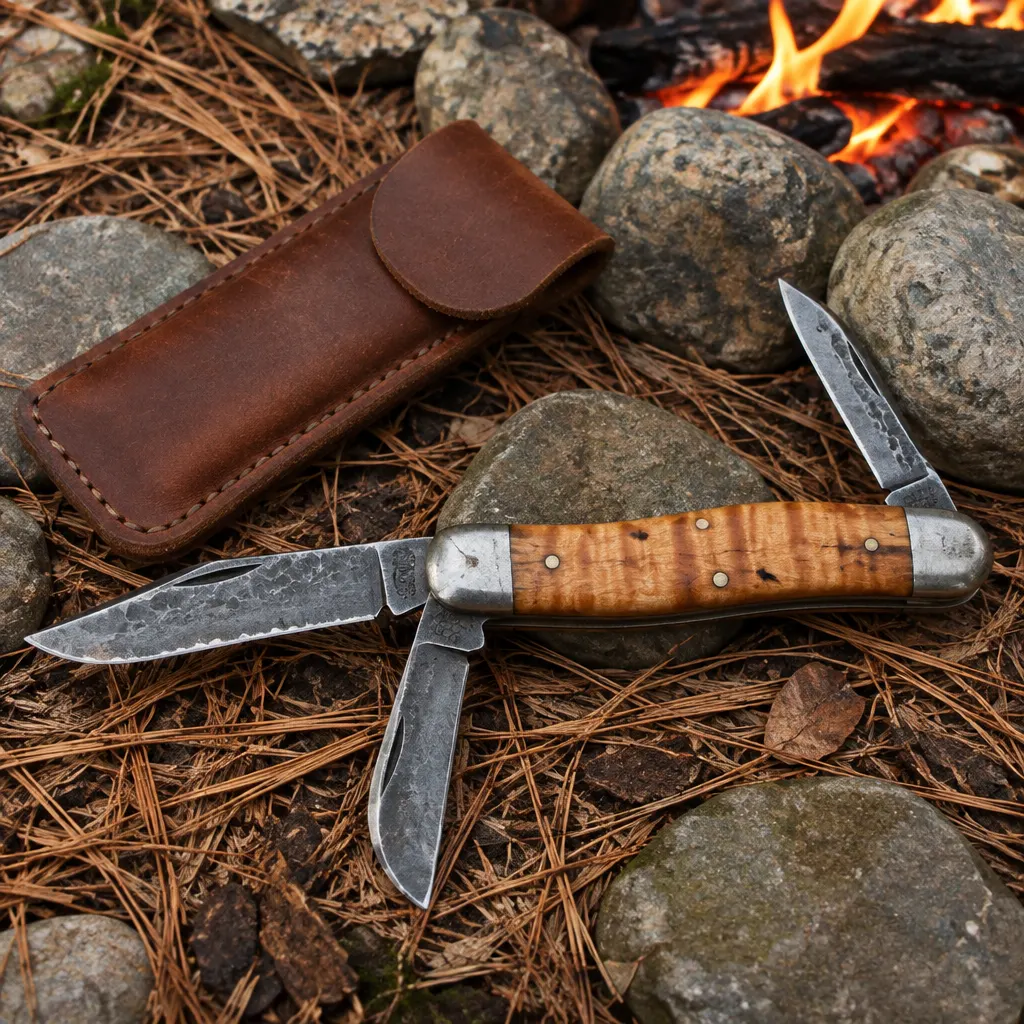
A stockman like the Jerry Cabin Stockman Pocket Knife, Bison Horn has three blades, and a trapper like the Pogue Creek Deer Antler Pocket Knife, Trapper has two. Sharpen each blade on its own with the others closed, so a half open blade is not waiting to bite you. The spey blade has a short, gently curved edge. Treat it like a small belly and lift the handle slightly at the curve.
Slip joints, lockbacks and friction folders
A lockback like the Armstrong Creek Lockback Pocket Knife, Osage Orange stays open while you sharpen, which makes it the friendliest folder on a stone. A slip joint is held open only by its spring, so keep your pressure light and your fingers out of the path the blade would take if it closed. A friction folder like the Cheoah Bald Friction Folder, Osage Orange has no spring and no lock at all. Hold it by the handle with your thumb pressing the extended tang down.
On slip joints, leave the kick alone. That is the small step at the base of the blade that rests on the spring when the knife is closed and keeps the edge from striking it. Grind that away and the edge starts to meet the spring every time you fold the knife.
Stropping and Touch Ups
Most of the time a pocket knife does not need a stone at all. It needs a strop. Draw the blade backwards along the leather, spine first, at the same angle, ten to fifteen passes a side. That straightens the edge and polishes off the tiny burrs that make a knife feel dull long before it really is.
Go back to the fine stone when stropping stops working, and to the medium stone only for chips or a very dull edge. Carbide pull through sharpeners are quick, but they tear steel off and leave a rough, uneven edge. On a hand forged blade they are a shortcut you will pay for.
When you finish, wipe the blade dry and put a thin coat of oil on it, since carbon steel will rust if you put it away wet. Our guide to sharpening a hand forged knife covers stone grits and the general whetstone method in more detail.
Common Mistakes
- Pressing too hard. Heavy pressure makes the angle wobble. Let the stone do the work.
- Changing the angle mid stroke. A rounded, convex edge is the result. Lock your wrist and move from the shoulder.
- Stopping before a burr forms. No burr means the two sides have not met at the edge yet, so the knife will not get sharp.
- Leaving the heel dull. Start every stroke right at the base of the edge, or you will slowly build a dull spot.
- Using a dry stone. Water or oil carries the steel away. A clogged stone stops cutting.
Still choosing a knife? Our guide to the best small pocket knife compares sizes and patterns, and you can browse the range in Pocket Knives and EDC Knives.
Questions and answers
What angle should I sharpen my pocket knife at?
About 17 to 20 degrees per side suits most pocket knives. Go a little lower for a thin blade used for whittling or slicing, and a little higher for a knife that cuts cardboard and dirty material all day.
How often should you sharpen a pocket knife?
Strop it whenever it starts to drag, which for a daily carry knife might be every week or two. Go back to the stones only when stropping no longer brings the edge back. Most people end up using a stone a few times a year.
Can you sharpen a pocket knife without a whetstone?
In a pinch, yes. The unglazed ring on the bottom of a ceramic mug works like a fine stone, and the back of a leather belt makes a decent strop. They will get you through a trip, but a proper stone does a better job.
Should both sides of the edge be sharpened the same?
On most pocket knives, yes. Give each side the same number of strokes at the same angle so the edge stays centered. A few specialty blades are ground on one side only, and those get a single light pass on the flat side to remove the burr.
Why will my pocket knife not get sharp?
Usually because the burr never formed, so the two bevels have not met, or because the angle kept changing. Go back to the medium stone, use the marker to check your angle and keep going until you can feel a burr along the full edge.
Pieces that go with this guide: Jerry Cabin Stockman Pocket Knife, Bison Horn, Burningtown Hawkbill Folding Knife, Curly Maple, Mount Guyot Sheepsfoot Folding Knife, Dogwood, Pogue Creek Deer Antler Pocket Knife, Trapper, Armstrong Creek Lockback Pocket Knife, Osage Orange and Cheoah Bald Friction Folder, Osage Orange.
Keep exploring
Shop by collection
- Native American-Style Knives
- Fixed Blade Knives
- Signature Collection
- EDC Knives
- Tomahawks & Axes
- Bearded Axes
- Throwing Axes and Tomahawks
- Tomahawks
- Double Bit Axes
- Axes & Hatchets
- Hunting & Skinning Knives
- Gut Hook Knives
- Skinning Knives
- Pocket Knives
- Antler and Bone Handle Knives
- Camp & Bushcraft Knives
- Neck Knives & Small Fixed Blades
- Bowie Knives
- Daggers
- Boot Knives
- Ring Pommel Knives
- Heritage Tools
- Fire Starting Kits
- Leather Awls
- Ulu Knives
- Gift Sets & Combos
- Damascus Knives
- War Clubs
- Spears & Lances
- Shop everything
Pocket Knives Worth Sharpening
High carbon steel folders that take a fine edge and give it back on any stone.
-
 New
Tilson Gap Damascus Stockman Pocket Knife, Bison Horn
3.75 in blade · Buffalo horn
A three blade stockman pocket knife with a 3.75 in hand forged Damascus steel blade, polished black bison horn scales, steel bolsters and a fitted leather belt pouch.
$345.00Free US shipping -
 New
Haoe Damascus Lockback Pocket Knife, Ram Horn
3.75 in blade · Ram horn
A lockback pocket knife with a 3.75 in hand forged Damascus steel clip point, ridged ram horn scales and a fringed leather belt pouch with beadwork.
$345.00Free US shipping -
 New
Black Bear Damascus Clip Folder, Horn
4 in blade · Buffalo horn
A big lockback pocket knife with a 4 in hand forged Damascus steel clip point, filework on the spine, black buffalo horn handle and a black leather belt…
$340.00Free US shipping -
 New
Elk Knob Damascus Neck Knife with Sheath, Ram Horn
3.25 in blade · Ram horn
A neck knife with a 3.25 in hand forged Damascus steel drop point, ridged ram horn scales and a brown leather sheath that hangs from the neck or…
$190.00Free US shipping


Keep Reading

Best Skinning Knife for Deer and Small Game: How to Choose
Blade shapes, gut hooks, blade length, grip and sheath: how to choose a skinning knife for deer and small game.

Felling Axe vs Splitting Axe: Head Shape, Weight and Handle
How felling and splitting axes differ in head shape, weight and handle length, and which one the job in front of you needs.

Ulu Knife History: The Woman’s Knife of the Arctic
Where the crescent knife came from, who used it, what it was made of before steel and how it became a kitchen favorite far from the Arctic.