What Is a Damascus Knife? Pattern Welded Steel, Wootz and Fakes
A Damascus knife is a knife whose blade shows a pattern in the steel itself: wavy lines, ripples or swirls that run through the metal and appear after the blade is etched. Today that almost always means pattern welded steel, made by forge welding two or more steels together and folding or twisting them. The name, and a good deal of the legend, comes from an older and quite different steel. Here is what a Damascus knife is, how it is made, and how to tell the real thing from a pattern that was printed on.

The Short Answer
- Modern Damascus is pattern welded steel. Layers of different steels are welded into one bar, worked into a pattern, then etched with acid so the layers show.
- Historic Damascus refers to sword blades made in the Near East from wootz, a crucible steel from India and Sri Lanka. Its pattern came from the structure of a single steel, not from layers.
- Fake Damascus is a plain steel blade with a pattern laser etched, printed or stamped onto the surface.
Strictly speaking, calling pattern welded steel Damascus is not correct. The knife trade has used the name that way for decades, though, and you are about as likely to change it as you are to get a knife maker to agree on the best steel.

Historic Damascus: Wootz Steel
The original Damascus blades were forged in the Near East from ingots of wootz steel imported from southern India. Wootz was a crucible steel, made by melting iron with carbon in a sealed clay vessel. Ingots were shipped from South India to the Middle East over many centuries, and smiths there forged them into swords with a distinctive watered pattern across the blade.
Nobody is completely sure where the name comes from. The most common explanation is the city of Damascus, where many of these swords were sold. Others point to an Arabic root meaning watered, which describes the look of the pattern, or to a smith named Damasqui mentioned by the scholar al-Biruni.
The pattern came from inside the steel
Wootz blades were not layered. The pattern came from bands of hard carbide particles that formed in the steel as it was made and forged. In research published in the late 1990s, metallurgist John Verhoeven and bladesmith Alfred Pendray showed that tiny amounts of elements such as vanadium in the steel played a key part in forming those bands.
Why the method was lost
Production of patterned wootz swords declined and had ended by around 1900. One proposed reason is that later batches of ore lacked the trace elements the pattern depended on. If that is right, the pattern could have disappeared simply because the ore changed, with nobody at the time able to say why.
Modern Damascus: Pattern Welded Steel
An old technique with a borrowed name
Pattern welding is a very old technique in its own right. It dates back to the first millennium BC, in Celtic and later Germanic swords. Early iron was uneven and often soft, so smiths welded layers of harder and softer metal together to get a better blade, and the layers made a pattern. Viking era smiths twisted bars of steel, welded them side by side and produced chevron patterns down the blade. The technique faded in Europe by the end of the Viking Age. The term pattern welding itself was coined by the English archaeologist Herbert Maryon in 1948.
The modern revival owes a lot to one man. In 1973 the American knife maker William F. Moran showed what he called Damascus knives at the Knifemakers’ Guild Show, and the name has stuck to pattern welded steel ever since.
How the pattern is made
- Stack the billet. Thin bars of two steels are stacked in alternating layers. A common pairing is a plain high carbon steel with a nickel bearing steel such as 15N20.
- Forge weld it. The stack is heated to welding heat and hammered or pressed until the layers fuse into one solid bar.
- Multiply the layers. The bar is drawn out, cut, restacked and welded again. Each round multiplies the number of layers.
- Make the pattern. Leave it as it is for a random pattern, twist it for a twist pattern, cut or press grooves into it for ladder and raindrop patterns, or split it with a wedge and forge it closed for a feather pattern.
- Forge, heat treat and grind the blade. At this point the blade looks like plain gray steel. The pattern is there but you cannot see it.
- Etch. The finished blade goes into an acid bath, often ferric chloride.
What the etch does
The two steels react to the acid differently. Plain carbon steel darkens. Nickel bearing steel resists the acid and stays bright. The result is the light and dark figure you see. Some makers follow the acid with a soak in strong coffee to deepen the dark layers. The etch also leaves the surface very slightly uneven, so on a deep etch you can sometimes feel the pattern under a fingernail.
Is Damascus Better Than Plain Steel?
A Damascus blade performs about as well as the steels it is made from and the heat treatment it gets. Good steels, good welds and a proper heat treat make a good knife. A beautiful pattern on a badly heat treated blade makes a pretty knife that will not hold an edge.
The risks are in the welding. A weld that did not fully take can leave a flaw or a small gap between layers, and that is where a blade can fail. Experienced makers grind out or reject bad billets. Inexperienced ones sometimes sell them.
So buy Damascus for the look and the craft, which is a perfectly good reason, and judge the knife the same way you would judge any other: by its edge, its fit and its finish.
The pattern does not cut anything. The edge does.
How to Spot a Fake Damascus Pattern
Plenty of cheap knives carry a pattern that was laser etched or printed onto one plain steel. The pattern only sits on the surface. These checks catch most of them:
| Check | Real pattern welded Damascus | Etched or printed fake |
|---|---|---|
| The spine | Layers show as lines running along the spine, because they go all the way through. | Spine is plain steel with no lines. |
| The edge bevel | The pattern continues into the bevel, often looking tighter as the grind cuts across the layers. | Pattern stops where the bevel starts, and the bevel is plain. |
| The pattern itself | Irregular and organic. The two sides are related but not identical. | Often too even, repeating like wallpaper, or mirrored exactly on both sides. |
| After sharpening and use | The bevel turns bright but the pattern on the flats stays. | The pattern scuffs or wears away from high spots. |
| The listing | Names the steels or describes the layers and the etch. | Says Damascus pattern, Damascus style or Damascus look. |
The spine check is the quickest. If a seller will not show you the spine of a Damascus knife, ask yourself why.
Caring for a Damascus Knife
- Keep it dry. Most Damascus includes high carbon steel, and that rusts. Wipe it dry after use and put on a thin coat of oil.
- No dishwasher. Heat, detergent and moisture are hard on the steel, the etch and the handle.
- Store it out of the sheath. Leather holds moisture, so do not leave the blade in it for months.
- Go easy on polish. Metal polish and abrasive pads on the flats wear down the dark layers and soften the contrast. A maker can re etch a faded blade.
- Expect a bright bevel. Sharpening cuts through the etched surface at the edge, so the bevel turns shiny. That is normal and does not mean the pattern is fake.
Our knife care guide covers oiling and storage in more detail, and how to sharpen a hand forged knife walks through the whetstone method that suits a Damascus blade.
Our Damascus Knives
We are adding pattern welded blades to the shop in their own collection, Damascus Knives. Each listing gives the details of that particular knife, so check the description for the blade length, handle and sheath. Pattern welded steel never comes out exactly the same twice, so expect small differences in the figure from one blade to the next.
If you prefer a plain hammered or forge finished blade, our hunting knives and pocket knives are hand forged in high carbon steel and take the same care.
Questions and answers
Is a modern Damascus knife real Damascus steel?
Not in the historic sense. Historic Damascus was wootz crucible steel, and that method was lost. Modern Damascus is pattern welded steel, and the knife world has called it Damascus since the 1970s. A real pattern welded blade is still genuine craft. It is a different steel from the old swords.
Does Damascus steel rust?
Most Damascus contains high carbon steel, so yes, it can rust if it is left wet. Dry it after use, keep a thin coat of oil on it and store it out of the leather sheath.
Why are Damascus knives expensive?
Because of the labor. The billet has to be stacked, welded, drawn out and restacked several times before a blade is even shaped, and any weld flaw can mean starting over. Very cheap Damascus is worth a close look at the spine.
Can you sharpen a Damascus knife?
Yes, the same way you sharpen any carbon steel knife, on a whetstone at a steady angle. The bevel will turn bright as you cut through the etch. The pattern on the flats stays.
Is Damascus stronger than regular steel?
Not automatically. Its strength depends on the steels used, the quality of the welds and the heat treatment. A well made Damascus blade is a fine working knife, and a poorly made one is not, however good it looks.
Pieces that go with this guide: the Damascus Knives collection, plus hand forged hunting knives and pocket knives in high carbon steel.
Keep exploring
Shop by collection
- Native American-Style Knives
- Fixed Blade Knives
- Signature Collection
- EDC Knives
- Tomahawks & Axes
- Bearded Axes
- Throwing Axes and Tomahawks
- Tomahawks
- Double Bit Axes
- Axes & Hatchets
- Hunting & Skinning Knives
- Gut Hook Knives
- Skinning Knives
- Pocket Knives
- Antler and Bone Handle Knives
- Camp & Bushcraft Knives
- Neck Knives & Small Fixed Blades
- Bowie Knives
- Daggers
- Boot Knives
- Ring Pommel Knives
- Heritage Tools
- Fire Starting Kits
- Leather Awls
- Ulu Knives
- Gift Sets & Combos
- Damascus Knives
- War Clubs
- Spears & Lances
- Shop everything
Damascus Knives
Pattern welded blades, forged and etched so the layers show.
-
 New
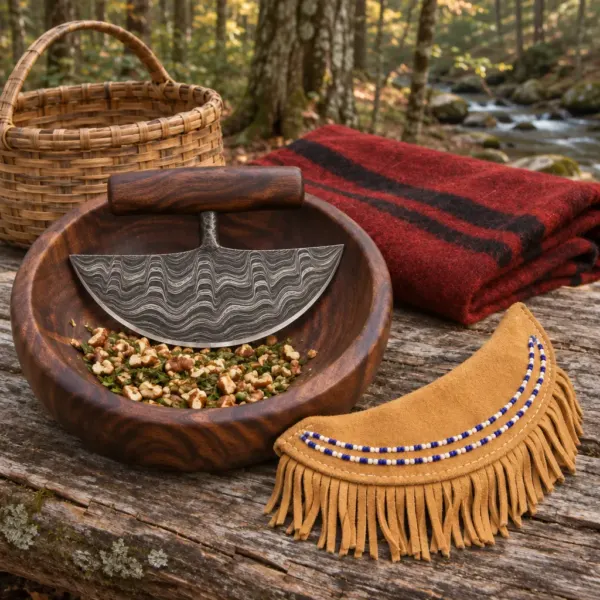
Coker Creek Damascus Ulu Knife and Bowl, Black Walnut
7 in wide overall · Black walnut
An ulu knife with a 6.5 in hand forged Damascus steel crescent blade, black walnut grip, a beaded buckskin cover and a 9 in turned walnut chopping bowl.
$305.00Free US shipping -
 New
Elk Knob Damascus Neck Knife with Sheath, Ram Horn
3.25 in blade · Ram horn
A neck knife with a 3.25 in hand forged Damascus steel drop point, ridged ram horn scales and a brown leather sheath that hangs from the neck or…
$190.00Free US shipping -
 New
Cataloochee Elk Damascus Lockback with Feathers
4 in blade · Buffalo horn
A large lockback pocket knife with a 4 in hand forged Damascus steel clip point, black buffalo horn handle, trade beads and two pigeon feathers, in a fringed…
$375.00Free US shipping -
 New
Tilson Gap Damascus Stockman Pocket Knife, Bison Horn
3.75 in blade · Buffalo horn
A three blade stockman pocket knife with a 3.75 in hand forged Damascus steel blade, polished black bison horn scales, steel bolsters and a fitted leather belt pouch.
$345.00Free US shipping


Keep Reading

Types of Spears: Boar Spear, Lance, Pike, Javelin and More
Boar spear, hunting spear, lance, pike, javelin and atlatl dart: how each type of spear was built and used, and how to choose one now.

Gifts for Men Who Have Everything: Knives, Hawks and Outdoor Gear by Budget
Hand forged knives, tomahawks and fire kits sorted by budget, with real prices, for the man whose drawer is already full of gadgets.

Throwing Hatchet Guide: Weight, Handle Length and Where to Stand
How heavy a throwing hatchet should be, how long the handle, where to stand and what wood to throw at, before you buy one or build a target.