The Mohican War Club: Gunstock Clubs in History and on Film
When people search for a Mohican war club, they nearly always mean one thing: the long gunstock club Chingachgook carries in the 1992 film The Last of the Mohicans. The club is real history. The name came from the movie.
The War Club in The Last of the Mohicans
Michael Mann’s film came out in 1992. It is based on James Fenimore Cooper’s 1826 novel and set in 1757, during the French and Indian War. Russell Means played Chingachgook, with Daniel Day-Lewis as Hawkeye, Eric Schweig as Uncas and Wes Studi as Magua. Means carries a large wooden gunstock club with a spear point set at the bend for much of the film, and it is the weapon he turns on Magua in the closing fight. It is hard to watch that scene and not want one, which explains a good share of the searches.
The club was not made by the film’s bladesmiths. Daniel Winkler, who made the knives for Hawkeye and Uncas and the tomahawk Magua carries, has said the big gunstock club came from the production’s own prop department. Knifemaker Randall King made Chingachgook’s dagger. Most of the film was shot in the Blue Ridge Mountains of North Carolina, standing in for the New York frontier.
Why it gets called a Mohican war club
The name is a search habit that grew out of the film. The weapon itself is the gunstock war club, and it was carried by many nations across a wide region, not by one people in particular. Cooper, for his part, set his story in Mohican country in the upper Hudson Valley but borrowed some names from the Mohegan, a separate people from eastern Connecticut. The Mohican people today are enrolled in the Stockbridge-Munsee Community in Wisconsin.
What Is a Gunstock War Club?
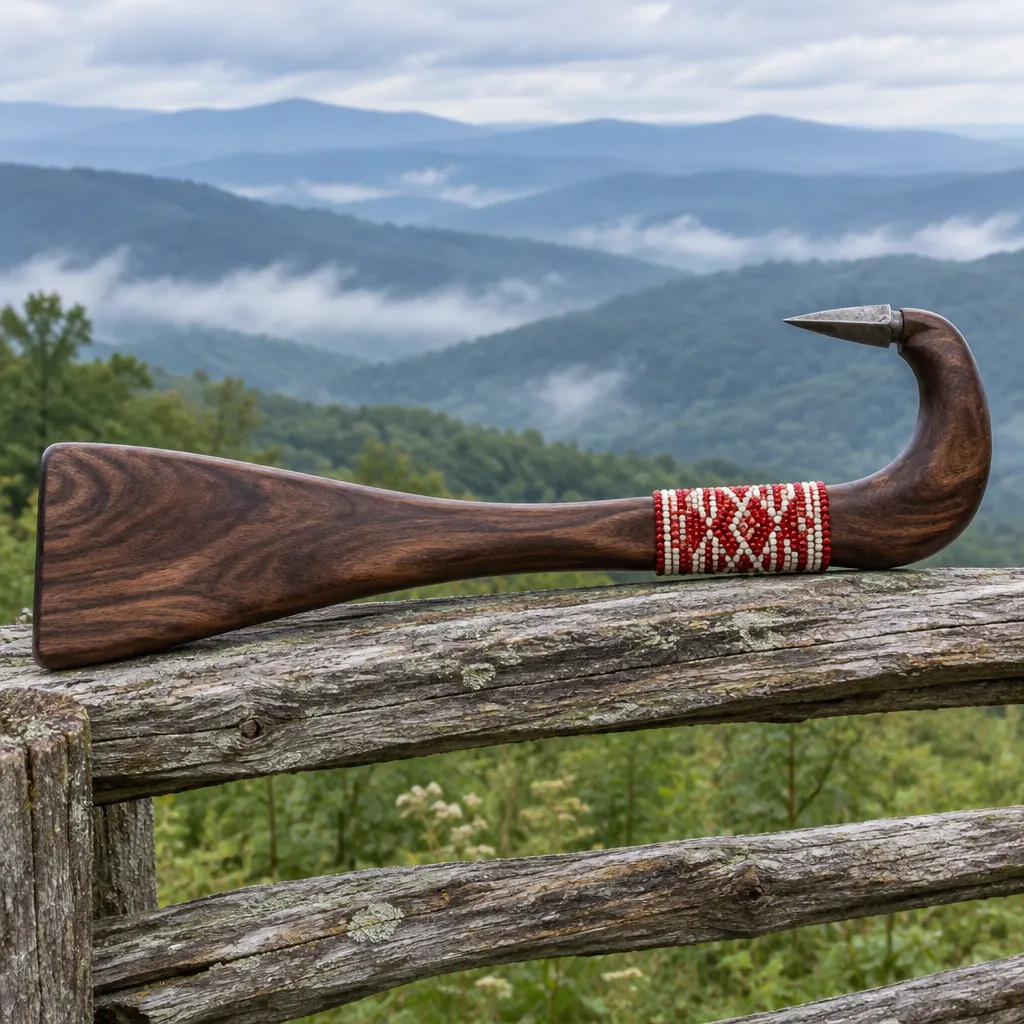
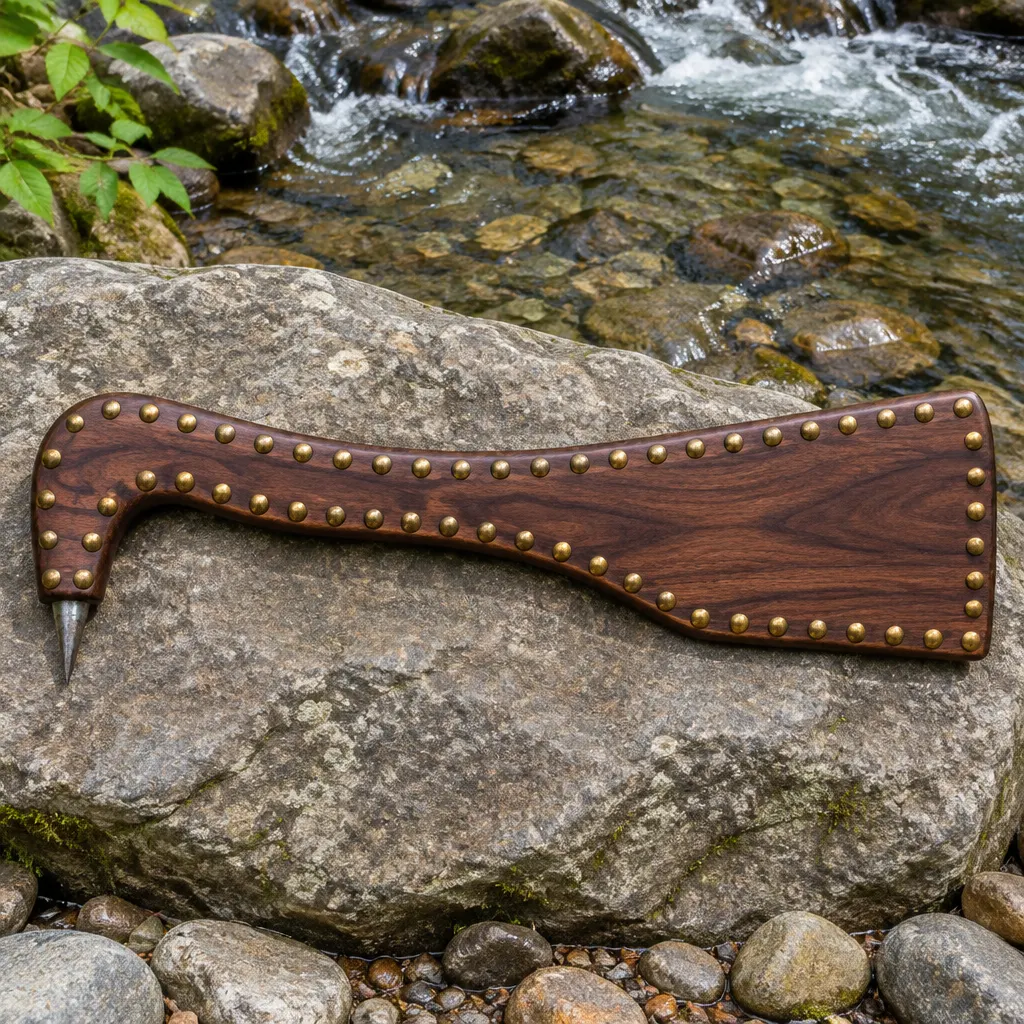
A gunstock war club is a flat wooden club cut in the outline of a musket stock. A long, straight grip widens into a broad head with a sharp angle partway along, often called the elbow. A blade or spike was usually set into the outside of that bend.
Makers worked in straight-grained hardwood such as maple, ash, oak, hickory or hornbeam, depending on what grew nearby, and most clubs weighed around two to three pounds. Blades could be flint, horn or iron, and as trade with Europeans grew, iron and steel became common. Many clubs were decorated with brass tacks and carved designs, some geometric and some pictorial.
Where the Gunstock Shape Came From
Gunstock clubs appear from the 1600s on and were most common in the 1700s and 1800s. They were used widely across the Eastern Woodlands, and by the middle of the 1800s Plains nations such as the Lakota were using them as well. For more on the trade goods and the knives of the same era, our Native American knives guide covers the background.
Where the shape came from is still argued over, and you should be suspicious of anyone who tells you it is settled. The most common view is that makers copied the stock of the European musket, a weapon that made a strong impression and was itself swung as a club once it had been fired. Another view is that the form developed on its own and only happens to look like a gun stock. One practical point gets raised often: a club cut down from a real musket stock would be weak, and the clubs that have been excavated show no sign of having started life as firearms.
By the second half of the 1800s, many war clubs were being made for ceremony and display rather than for fighting.
Where the shape came from is still argued over. Be suspicious of anyone who tells you it is settled.
Gunstock Club vs Other War Clubs
The gunstock club is one of several war club forms. Our war clubs collection covers three of them, and the differences are easy to see side by side.
| Type | Head | Overall length in our range | Weight in our range |
|---|---|---|---|
| Gunstock club | Flat gunstock-shaped body with a forged steel point at the bend | 25 to 28 in | 26 to 33 oz |
| Ball headed club | Carved wooden ball, one piece with the handle | 20 to 24 in | 23 to 32 oz |
| Stone head club | Smooth river stone bound in rawhide | 20 to 24 in | 25 to 30 oz |
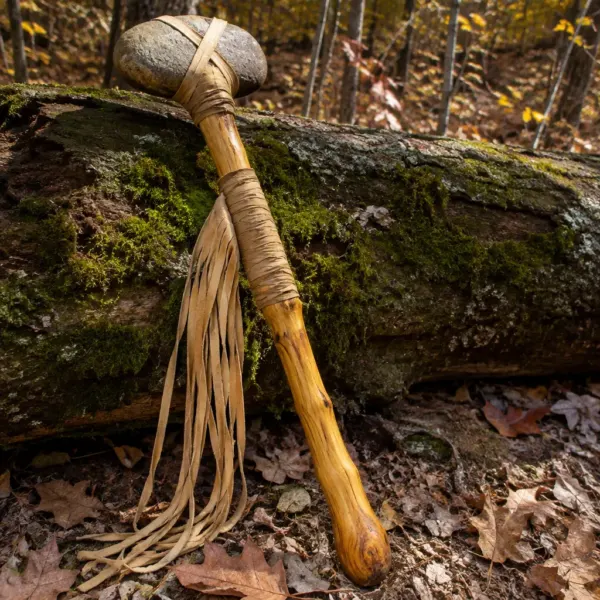
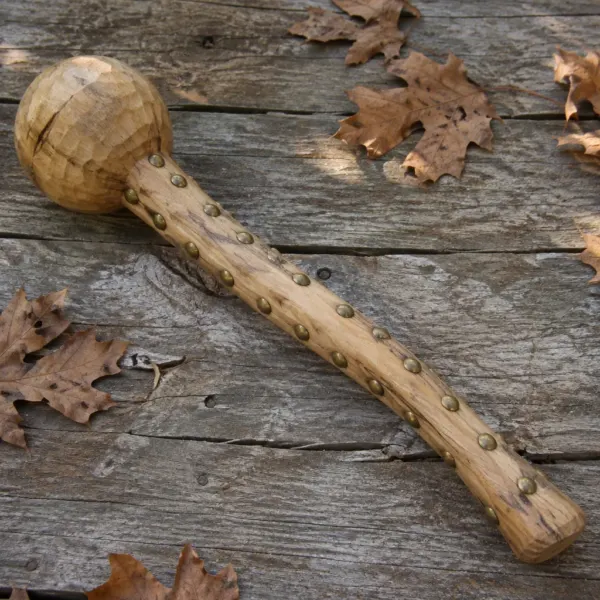
The ball headed club is carved from a single piece of hardwood, with a round knob at the end of a curved neck, and it is the other classic club of the Eastern Woodlands. The Etowah Traditional Wooden War Club is a good example in osage orange. A stone head club binds a smooth river stone to a wooden haft with rawhide.
Our Gunstock War Clubs
There are four gunstock war clubs in the range right now. Each has a flat gunstock-shaped body with a hand-forged high-carbon steel point set at the bend, and all of them are made as display and collector pieces, not as tools for hitting things. They differ in wood, size and finish.
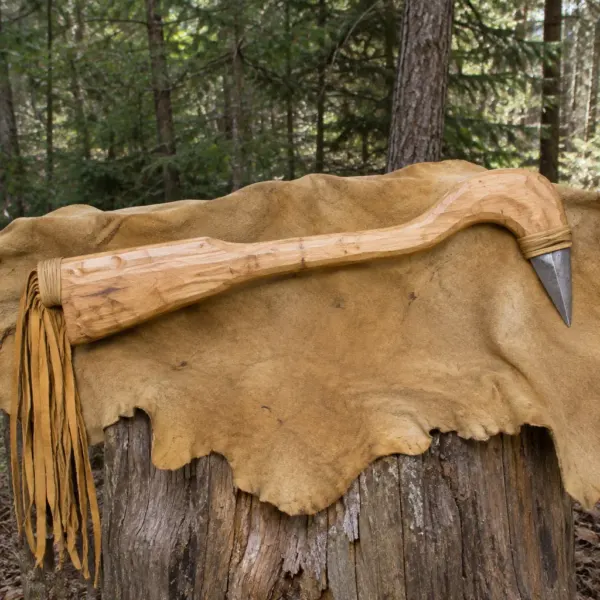
- Turkeypen Gap Gunstock War Club, Hickory: the longest of the four at 28 inches and 29 ounces, pale straight-grained hickory with a hammered steel point and a fringed buckskin drop at the grip.
- Relief Gunstock War Club, Osage Orange: 26 inches and 30 ounces, golden osage orange with a dark acid-etched point and a wrap of turquoise and black pony beads below the head.
- Bird Mountain Gunstock War Club, Black Walnut: 25 inches and 26 ounces, dark walnut with rows of brass tacks set along the haft in the old style.
- Hurricane Mountain Gunstock War Club, Black Walnut: the heaviest at 27 inches and 33 ounces, with a wrap of red white-heart and white pony beads below the head.
Choosing and Displaying a Gunstock Club
Pick by length and wood first. A longer club reads better on a wall over a fireplace, and a shorter one suits a shelf or a deep shadow box. Hickory is pale and plain. Black walnut is dark and quiet. Osage orange is bright yellow when new and darkens toward brown with age and light, so the club you hang this year will not be quite the club you look at in ten years. Decoration comes down to taste. Brass tacks echo many of the old clubs, while beads and buckskin add color.
Hang the club on two padded pegs or a simple bracket, one under the head and one under the grip, away from a heater or a sunny window. Wipe the wood with a little oil or paste wax once or twice a year, and keep a light coat of oil on the steel point, since high-carbon steel will rust if it sits damp. If you want a tomahawk on the wall beside it, our guide on how to choose a tomahawk covers the patterns, and the tomahawks collection has plenty that pair well with a club.
Questions and answers
What is the Mohican war club called?
It is a gunstock war club, named for its outline, which looks like the stock of a musket. “Mohican war club” is a nickname that comes from the 1992 film The Last of the Mohicans.
Who carries the war club in The Last of the Mohicans?
Chingachgook, played by Russell Means. He carries a large gunstock club through the film and uses it in his final fight with Magua, played by Wes Studi.
Did Native Americans really use gunstock war clubs?
Yes. Gunstock clubs were used by many nations in the Eastern Woodlands and later on the Plains, mostly in the 1700s and 1800s. Old examples survive in museum collections today.
Why is a gunstock club shaped like a gun?
Nobody knows for certain. The most common view is that makers copied the musket stock, but some historians argue the shape developed independently. Excavated clubs show no sign of having been cut down from real guns.
What wood were gunstock clubs made from?
Straight-grained hardwoods such as maple, ash, oak, hickory and hornbeam, depending on the region. Ours are made in hickory, osage orange and black walnut.
Can you use one of these war clubs?
Ours are made as display and collector pieces, so they belong on a wall or a shelf, not in a fight or a woodpile. If you want something hand-forged to actually swing and throw, a plain throwing tomahawk is the better buy.
Pieces that go with this guide: Hurricane Mountain Gunstock War Club, Black Walnut, Bird Mountain Gunstock War Club, Black Walnut and Etowah Traditional Wooden War Club, Osage Orange.
Keep exploring
Shop by collection
- Native American-Style Knives
- Fixed Blade Knives
- Signature Collection
- EDC Knives
- Tomahawks & Axes
- Bearded Axes
- Throwing Axes and Tomahawks
- Tomahawks
- Double Bit Axes
- Axes & Hatchets
- Hunting & Skinning Knives
- Gut Hook Knives
- Skinning Knives
- Pocket Knives
- Antler and Bone Handle Knives
- Camp & Bushcraft Knives
- Neck Knives & Small Fixed Blades
- Bowie Knives
- Daggers
- Boot Knives
- Ring Pommel Knives
- Heritage Tools
- Fire Starting Kits
- Leather Awls
- Ulu Knives
- Gift Sets & Combos
- Damascus Knives
- War Clubs
- Spears & Lances
- Shop everything
Hand-Made War Clubs
Gunstock, ball headed and stone head clubs, made as display and collector pieces.
-
 New
Slickrock Creek Stone Head War Club, Osage Orange
3.75 in blade · Osage orange
Stone Head Club with a smooth river stone head bound in rawhide, on osage orange.
$245.00Free US shipping -
 New
Turkeypen Gap Gunstock War Club, Hickory
4.25 in blade · Hickory
Gunstock Club with a flat gunstock-shaped body with a forged steel point set at the bend, hand-forged in high-carbon steel, on hickory.
$365.00Free US shipping -
 New
Soque Ball Headed War Club, Hickory
3.25 in blade · Hickory
Ball Headed Club with a carved ball head, one piece with the handle, on hickory.
$205.00Free US shipping -
 New
Stratton Bald Stone Head War Club, Osage Orange
3.5 in blade · Osage orange
Stone Head Club with a smooth river stone head bound in rawhide, on osage orange.
$265.00Free US shipping
Keep Reading

The Best Hunting Knife for Deer, Elk and Hog: How to Choose
Blade shape, length, steel and sheath for deer, elk and hog, and how to tell whether one good knife will do or a set is worth it.
What Is a Gut Hook? What It Does and How to Use One
What the hook on the spine of a hunting knife is for, how to use it on a deer, how to sharpen it and whether you need one at all.
How to Choose a Tomahawk: Head Shapes, Haft Length and Weight
Head shape, haft length and weight: what matters for camp work, what matters for throwing and what matters on the wall.