How to choose a wooden walking stick
There are two kinds of stick on this page. A walking stick is the shorter kind with a handle at the top, held like a cane on town walks, farm lanes and level trails. A hiking staff is taller and gripped around a leather wrap, so you can choke up on the way uphill and reach down on the way back. Pick the kind first, then the wood and the look.
Walking stick or hiking staff?
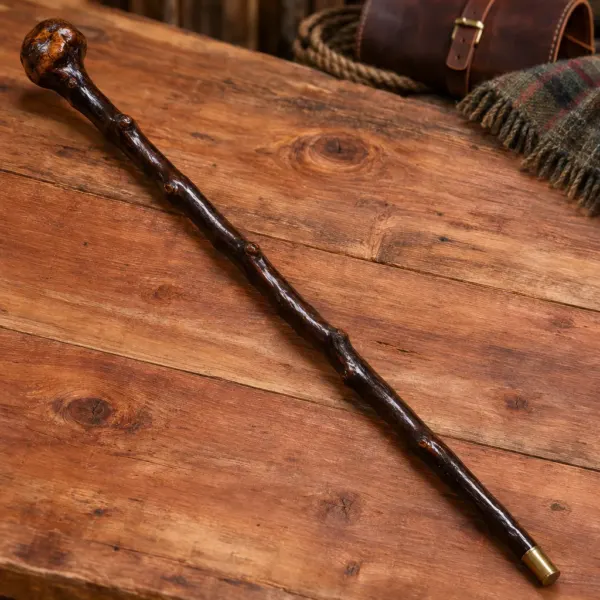
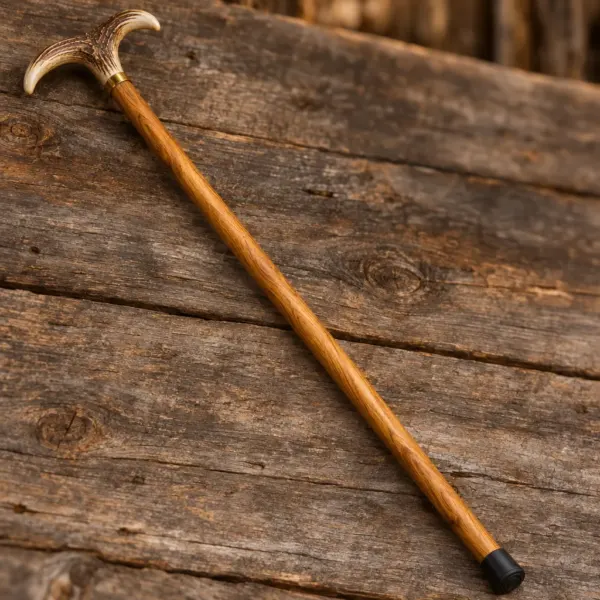
Our short sticks are 36 and 38 in long. The Hickory Walking Stick with Whitetail Antler Handle has a whitetail antler T handle that sits across the palm, a brass collar and a rubber foot. The Blackthorn Style Shillelagh with Root Knob Handle has a root knob handle. Our hiking staffs run from 50 to 55 in, long enough to plant ahead of you on a slope and lean on when you cross a creek.
What height walking stick do you need?
One simple rule from scouting: stand with your arms at your sides, and a hiking staff should come to about 8 in above your elbow. Go a little longer for steep ground. For level walking, a shorter stick that reaches around your waist works well. Stand a broom handle next to you and mark the height, and you will soon see which of our lengths suits you.
Hickory or ash
Both are tough, springy hardwoods that have been used for tool handles for generations. Hickory is heavier and very hard to break, and we use it for the antler handle stick, the shillelagh and the plain hiking stick. Ash is a little lighter with a straight grain, which makes it a good base for the carved and beaded staffs.
Antler handle walking stick
Antler handles are a classic on walking sticks. Besides the whitetail T handle stick, the Diamond Willow Style Walking Stick with Elk Antler Cap is a 52 in ash staff with an elk antler cap and a leather wrist thong. Its diamonds are carved by hand and darkened to a reddish brown against the pale wood, the way real diamond willow looks. Every antler piece is a little different in shape and color.
Shillelagh
A shillelagh is the Irish walking stick, traditionally cut from blackthorn with the knob of the root left on as the handle. Ours is made in that style from a hickory sapling with its root knob, 36 in long, stained dark and finished to a high gloss, with the small bumps where side shoots were trimmed left on the shaft. A brass ferrule protects the tip.
Carved and beaded walking sticks
The Carved Hiking Staff with Feather Carving and Leather Grip is 55 in of ash with a hand carved feather and spiral band near the top, the cuts darkened so they stand out, a deer leather grip and a brass ferrule. The Beaded Walking Stick with Buckskin Grip and Fringe is 50 in long with a buckskin grip, a 3 in band of red, white, black and turquoise pony beads, fringe and brass tacks. Both are made to be walked with, and both look good standing in a corner between trips.
Rubber foot, brass ferrule or forged tip
The tip decides where a stick feels at home. A rubber foot, on the antler handle stick, the beaded stick and the diamond willow style staff, grips pavement and does not mark floors. A brass ferrule, on the carved staff and the shillelagh, protects the end of the wood. The Hickory Hiking Stick with Leather Lace Grip and Forged Tip has a hand forged steel tip that bites into dirt and gravel on the trail.
Compare our walking sticks
| Stick | Length | Materials | Tip | Price |
|---|
| Hickory Walking Stick with Whitetail Antler Handle | 38 in | Hickory, whitetail antler handle, brass collar | Rubber foot | $145 |
| Carved Hiking Staff with Feather Carving and Leather Grip | 55 in | Ash, deer leather grip, wrist thong | Brass ferrule | $125 |
| Blackthorn Style Shillelagh with Root Knob Handle | 36 in | Hickory sapling with root knob | Brass ferrule | $115 |
| Beaded Walking Stick with Buckskin Grip and Fringe | 50 in | Ash, buckskin grip, pony beads, fringe | Rubber foot | $165 |
| Diamond Willow Style Walking Stick with Elk Antler Cap | 52 in | Ash, elk antler cap, wrist thong | Rubber foot | $175 |
| Hickory Hiking Stick with Leather Lace Grip and Forged Tip | 55 in | Hickory, leather lace grip, wrist thong | Hand forged steel tip | $85 |
Caring for a wooden walking stick
Wipe the stick down after a wet or muddy walk and let it dry at room temperature, not next to the fire. Rub in a little oil once or twice a year to keep the wood from drying out. Keep antler out of standing water and hot cars. Leather grips and thongs like a bit of leather conditioner now and then.
A walking stick as a gift
A good stick makes a thoughtful gift for a hiker, a hunter, a grandparent who walks the property every morning or anyone with Irish roots who would enjoy a shillelagh by the door. See the gift guide for more ideas. If you need a length we do not list, ask about it on our custom orders page.
Heading out to the backyard instead of the trail? Our slingshots, atlatls and throwing targets are in the same outdoor and camp section.
Questions and answers
How tall should a walking stick be?
For a hiking staff, a common rule is about 8 in above your elbow with your arms at your sides, a bit longer for steep country. For a short walking stick used like a cane on level ground, around waist height is right. Our sticks come in 36 to 38 in and 50 to 55 in lengths.
What is the best wood for a walking stick?
Hickory and ash are two of the best. Both are tough and a little springy, so they take a knock without snapping. Hickory is the heavier and harder of the two, while ash is lighter with a straight grain.
What is a shillelagh?
A shillelagh is a traditional Irish walking stick, usually blackthorn, with a heavy knob at the top made from the root. Ours is a blackthorn style shillelagh made from a hickory sapling with its root knob, stained dark and finished to a gloss.
Is a wooden hiking stick better than a trekking pole?
They do different jobs. A trekking pole is lighter, adjusts in length and packs down small. A wooden staff is solid, quiet and does not collapse or rattle, and it looks a lot better leaning by the door. Many people use a pole for long trips and a wooden stick for everyday walks.
Can I use a walking stick on pavement and floors?
Yes, pick one with a rubber foot: the antler handle stick, the beaded stick or the diamond willow style staff. The forged steel tip is made for dirt trails and will scratch hard floors.
Every walking stick is made to order, ships free in the US and is covered by our limited lifetime warranty.




 Antler and Bone Handle Knives133
 EDC Knives284
 Fixed Blade Knives602
 Forged Goods21
 Horn, Antler and Bone26
 Kitchen and Table17
 Knife Accessories52
 Leather Goods32
 Machetes6
 Native Style Decor11
 Outdoor and Camp16
 Signature Collection421
 Pocket Knives130
 Hunting & Skinning Knives214
 Bowie Knives92
 Daggers78
 Ring Pommel Knives61
 Camp & Bushcraft Knives94
 Neck Knives & Small Fixed Blades101
 Tomahawks & Axes299
 Gift Sets & Combos31
 Native American-Style Knives750
 Ulu Knives44
 Heritage Tools54
 War Clubs14
 Spears & Lances12